
Discovering My Family's ATTR Story: A Chance Meeting

I have the Thr60(80)Ala mutation on the TTR gene on the 18th chromosome. Pretty cool. It causes ATTR amyloidosis. Not cool.
1,600 or 1,700 years ago, a mutation happened in the northwest of County Donegal, Ireland. 1,600 years is a very long story. I once asked a geneticist, "how old is my mutation? How do you figure that out?" His reply was simply, "genealogy." So I began to trace my family history.
What is the ATTR amyloidosis gene mutation?
As it turns out, of the 127 amino acids that make up each of the 4 parts of the TTR tetramer transport protein, one was switched. Just one. Threonine was switched to Alanine at the 60th position (80th in the new nomenclature), T60(80)A. It seems so minor, so insignificant. Just one of 127, but it can cause the protein to break apart and clump into a waxy substance that fails at its job and makes this rogue protein lethal.
This is the Irish mutation.
At this time, there are more than 125 other mutations of this protein that can cause this disease, but only one is Irish. Wow, the problem in a nutshell.
How I began to trace my family history
In Ireland, it is known as Donegal Amy, and in my lineage, in my family, it goes back to that one person, perhaps 1,600 years ago, who had the original mutation. Conall Gulban mac Néill, son of Niall Noígíallach, 'Niall of the Nine Hostages', high king of Ireland, was the founder of Tír Chonaill or Donegal in the 5th century. Some think Conall had the mutation. Seems like a stretch to me, but sure, let's go with it.
I am not the only family member with ATTR
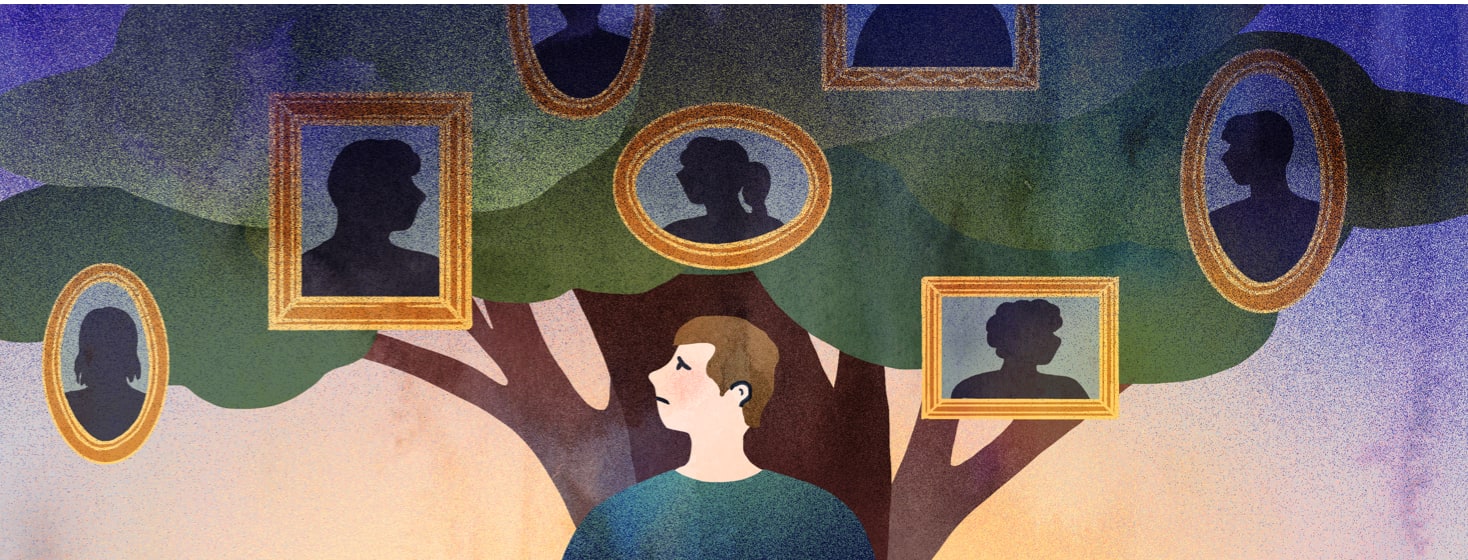
So roughly in the year 400, this journey begins. And everyone since who has this mutation is related to me. My mother had this disease, as did two of her sisters and a brother. I have first cousins in Indiana, Michigan, and Montana with the disease, and we talk. It is difficult, but I try to wrap my head around this, and I wonder about the beginning of this journey and the genetic connection I have with so many others.
Who were they, and how many of their descendants still live in County Donegal today?
Researching my genealogy connected me to others
So I dug in. Each generation that preceded me - my mother, my grandmother - had to be explored. It was painfully clear to me from the beginning of this search that I'm dealing with real people who had lives and loves; they worked hard, raised children, and led the lives of the day. They were not kings and queens, and not just a name on a family tree. Brothers, sisters, aunts and uncles all in a bloodline that became less clear as time went back. If back then nobody had yet defined the disease, then how would I know somebody died of it? I hit a wall. Sure, they died young, but was it amyloidosis? Or a mine cave-in in Appalachia? Perhaps cholera or the flu.
Start a Forum
Finding my family in Ireland
A new strategy hit me. There are people today walking around with the T60A mutation. People today are still dying from it. Knowing that it is from the Northwest coast of County Donegal, THAT'S where I should begin. Find my living 'cousins' and try to find our common ancestor.
It is thought that over 1% of those in Donegal have this disease. Considering that in 2023 County Donegal had 167,000 people, I have at least 1,670 living cousins in Donegal to get to know. Then there is the rest of Ireland, Great Britain, and the Irish diaspora.
How I used Facebook to learn about ATTR
My first move: join the Irish support group on Facebook and make contact with members.
Second, get the book. It turns out, one of my Irish 'cousins', Rosaline Callaghan, who founded the support group, wrote a book, "Donegal Amy: A Rare Inherited Disease From Ireland." Wow, a great start.
My next move was to compare the common names of people I know in Ireland with my family tree. Recent obituaries will sometimes list amyloidosis as the cause of death, and nothing beats contacting someone directly. Facebook is great for this.
This or That
When connecting with others, what's been more valuable to you?
You are not alone
I like to tell folks that they are not alone with this disease. There are others with your mutation, and that connectedness adds a new dimension to your community. I now see myself in this temporal space sharing ancestors, their happiness and sorrow, and knowing that I have a history I never before considered. A connection to a foreign land that was only talked about.
In a sense, my story is the story of Ireland itself. I think of those other mutations — the West African, Portuguese, German, all the rest. They all have their own story.
My family is only one tale on this long journey, but it's a big part of the story still being told.
Join the conversation