
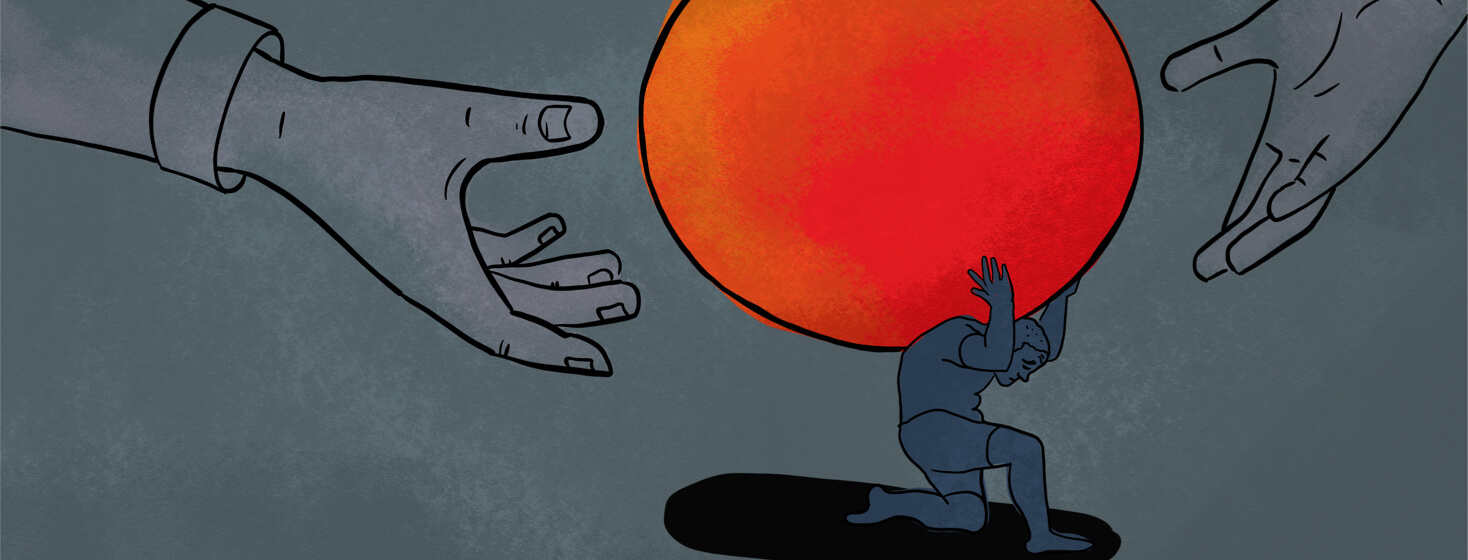
Carrying the Weight

To everyone touched by transthyretin (ATTR) amyloidosis; through diagnosis, genetics, or love, come sit with me for a moment.
March. Spring. Renewal.
For me, March for the last six years has felt like a permanent weight. Why?
Remembering loss to ATTR
It used to mean celebrating my dad’s birthday. My birthday. A day apart. Life. Joy. A reminder of how closely tied we always were.
Now it is for remembering loss, but it is also for facing uncertainty.
When I talk about hereditary amyloidosis V122I, I often talk about advocacy, mission, and mostly Dad. What I avoid, or simply do not have adequate space for, is talking about what it feels like to be a carrier.
My annual evaluation as a symptomatic carrier
March, for me, signifies returning for my annual evaluation.
My current status: symptomatic V122I carrier, unconfirmed diagnosis. Treated with diflunisal.
Two days of testing where I hold my breath until the end of the week to learn this year’s verdict, asking:
- Am I stable?
- Has something changed?
- Are my kidneys okay on diflunisal?
- Is there something subtle that we are not yet naming?
Living in the in-between is not without its challenges.
Sure, there is reassurance from the medical community that you are benefiting from earlier recognition and awareness, saying:
- “There has been real therapeutic progress.”
- “This is not the same disease, and it will not be the same outcome for you as it was for your father.”
And I believe that. I truly do.
This or That
Does ATTR run in your family?
Gene carriers face anxiety and uncertainty
But what often goes underrecognized in conversation, and even in published literature, is the heavy weight that sits with the carrier.
The anxiety of being a growing, unseen part within a disease space that, even in its advanced stages, remains invisible to many. The quiet mental load of knowing something lives in your DNA while not fully knowing what it will demand of you.
Featured Forum
View all responses"Early recognition and awareness," to me, has not always felt positive. Early has often felt like: “we are not ready for you yet, Erin. But trust us, it will be okay.”
The reality is that it is okay, as a patient, to feel scared, overwhelmed, and even angry that there is not yet a clear path for you.
How I cope with the unknown
The question then becomes: how do you live in the in-between without letting those emotions consume you?
I do not think this question has a one-size-fits-all answer. We each work to figure out how to carry it in our own way.
For me, it has meant finding places where I feel resonance. Community. The comfort of not having to overexplain how I feel, and knowing that it is okay to feel it.
It has meant finding hobbies and developing skills that ground me holistically. The answer to a full life and health, for me, is only partly measured by what medicine can quantify.
The rest is up to me.
The load feels lighter when I:
- Keep myself knowledgeable in the disease space that impacts my family.
- Create a mission that aims to help my community find its place within uncertainty.
- Use art, in its many forms, as an outlet.
- Have faith in what is spiritual in nature, alongside what is scientific.
What helps you stay grounded through uncertainty may look completely different. And that is okay.
However, remember this: we all have seasons where this journey feels isolating. But we have also found one another. And that matters.
Let’s continue the journey together.
Join the conversation