
My Family's Diagnosis Journey: And So, It Begins...

It all started in the spring of 2002, my awareness that is. We had left our home of 15 years in Seattle to settle for the next 20 years in Syracuse, NY. We were settling into academic life when we came back to Washington State for my daughter’s college graduation, and for the first time since my father passed, the family would finally be back together again. Moreover, this gathering was going to be an even more special time because my future son-in-law had asked me for my daughter’s hand in marriage and was going to propose. His Grandmother’s ring. Old school I know. But for the record, I said it was not my decision, but that he had my blessing.
The first sign of illness in my brother
We were gathering in front of the stadium, tickets in hand, and up came my brother. He was 59 at the time. He was my hero. Ten years my senior, he had lost his cherished younger brother to Leukemia six months before I was born, and so he had always felt he needed to watch over me. He ambled up to us, cane in hand, with his wife helping him balance.
I cannot convey the shock of seeing him in his condition. The image will be with me forever. A shell of himself -- my once vibrant, athletic brother -- was a walking skeleton. It had been a year or so since I’d seen him last and I knew he’d been ill, but this was devastating for me. It was supposed to be a happy occasion.
Featured Forum
View all responsesSeeking a diagnosis for a rare condition
When queried on the subject he had no answer to his condition. No diagnosis. He said, “the docs are working on it.” In the ensuing months the word “amyloidosis” came up. Many varieties exist, some more lethal than others. Not much they could do about it even if he was diagnosed. The culprit came forward in a 2003 genetic test, ATTR Amyloidosis.
So, with me as his helper, we started researching the disease. He in Boulder, and me in Syracuse. At this time, the hereditary form of the disease was considered extremely rare, however, some research into it had been done. After all, it is a disease passed down through families, through generations of families so its rarity could be a result of under-diagnosis and not the lack of those affected.
This or That
Does ATTR run in your family?
Understanding the results of genetic testing
Further exploration into his genetic test revealed a particular mutation. The amino acid threonine was replaced with alanine at the 80th position on the TTR gene on the 18th chromosome, T80A (old nomenclature is T60A). Further, this mutation has its origin on the north-west coast of County Donegal in Ireland. My father is of German heritage, but my mother’s people came from Ireland, some from Ulster in the northern counties of Ireland. So, there it is; an Irish gene mutation.
Featured Forum
View all responsesNavigating the path of hereditary ATTR amyloidosis
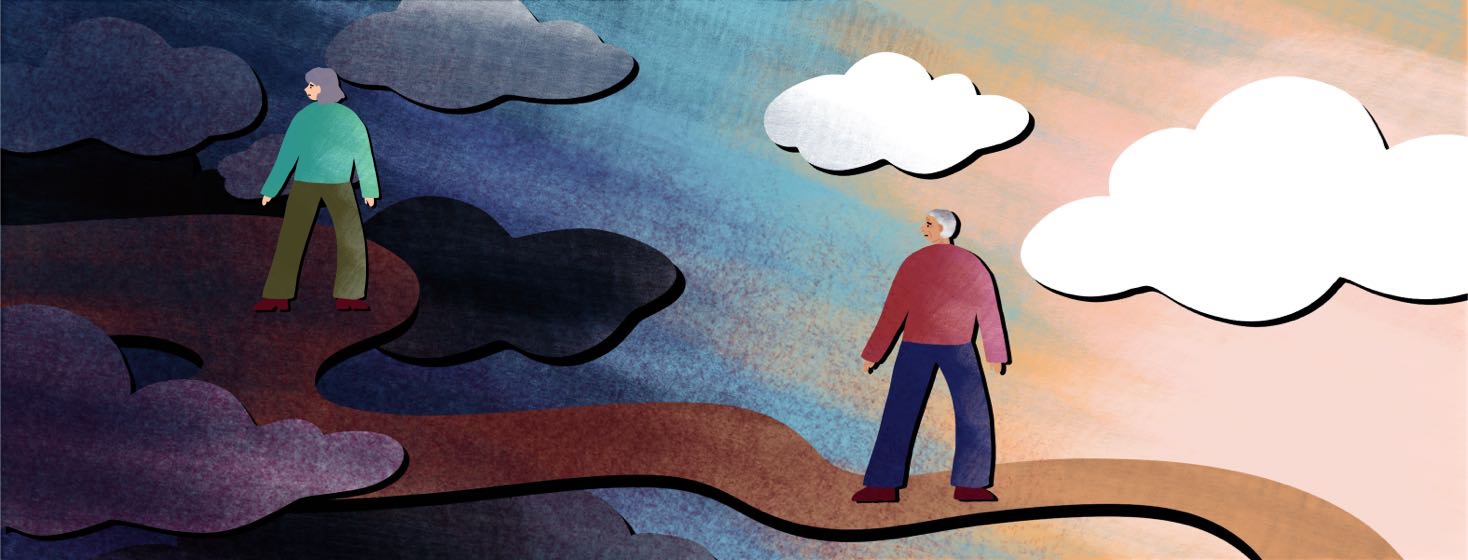
It's funny when a journey starts taking unexpected twists and turns. Both of us were outdoor guys, and both of us knew well the meanders and the bushwhacking of Colorado mountain trails. It’s what we grew up with, it’s what we knew. My brother’s condition was now known to us. But what to do? Heart and liver transplants? Then another discovery. A 2004 study found that a thirty-year-old NSAID, Diflunisal, can help control the amyloids in your blood. An amazing ray of hope, like the trail just took a positive more responsive turn. Just the sense that the medical world recognized this ultra-rare disease, could find solutions, gave us a positive pause. Time to catch our breaths. This was the hardest mountain we had ever tried to climb.
My brother started taking Diflunisal immediately, and though not yet diagnosed with ATTR amyloidosis I cajoled my rheumatologist (psoriatic arthritis, ugh) to switching me off ibuprofen and putting me on Diflunisal, just in case. My brother’s path took a downhill turn; he reached the end of his trail and passed from heart failure early in 2007. I was 54, he was 64.
Raising awareness and battling misdiagnosis
This is a story about the beginning of my journey. My solo trail would continue up the mountain. There was still a long uphill battle to fight. I did everything I could to get my doctors to realize what ATTR amyloidosis was, how to test for it, and how to treat it. This was now my fight. And as it turned out, the fight of several of my cousins. The widespread recognition of this disease was also now my struggle. After a few wrong diagnoses with unrelated conditions, I was finally diagnosed by a genetic test in 2014 as having T80A hereditary Transthyretin Amyloidosis.
So, now I know. I’ll admit, I was scared. I did want to know, and yet, I didn’t want to know. Will I face the horrors of my brother’s condition? My journey continues. Another mountain to climb.
Join the conversation