
ATTR Progress and Awareness: Maybe We Are Making a Difference After All

Are you an advocate? Don't forget to enter our giveaway this month for an Amyloidosis Awareness water bottle & gift card for Cushion Lab.
I walked into my appointment today carrying more than my purse and a list of medications.
I carried nerves.
After 15 years with the same primary care doctor, I was meeting someone new. My doctor had retired, and while I was happy for her, I dreaded starting over. Anyone living with a rare disease knows exactly what I mean.
Why we end up explaining rare diseases to new doctors
Would I have to explain transthyretin (ATTR) amyloidosis again?
Would I get the blank stare I've seen so many times before?
Would I have to spell out the name, explain what amyloidosis is, explain that it isn't just a heart disease, explain how it affects my stomach, my nerves, my energy, and nearly every aspect of my life?
A family history of ATTR amyloidosis
When my dad was diagnosed with ATTR in 2009, hardly anyone had heard of it. Most people couldn't pronounce it, much less understand it. There were no commercials. There weren't patient stories everywhere. There weren't support groups filled with people sharing their experiences online.
Back then, we felt like we were navigating an unknown world with very few answers.
My dad passed away in 2010, and I often wonder what he would think if he could see how much awareness has grown since then.
I saw more progress and awareness with my new doctor
As I sat in the exam room waiting for my new doctor, all of those thoughts were running through my mind. I was preparing myself for the familiar speech I've given countless times over the years.
Then something unexpected happened.
She walked in and knew what ATTR was.
Just like that.
No explanation required.
No confused look.
No "Can you spell that for me?"
She knew.
I was honestly shocked.
Years of advocacy are making a difference
For a moment, I just sat there taking it in. What had become second nature to me - having to educate every medical professional I encountered - wasn't necessary this time.
And suddenly, I realized something.
Maybe all of this advocacy is making a difference.
Maybe the videos matter.
Maybe the articles matter.
Maybe the advisory boards matter.
Maybe the interviews, the awareness campaigns, the patient stories, and the countless conversations matter more than we realize.
This or That
Are you looking for support or information?
Why living with ATTR amyloidosis means telling our stories
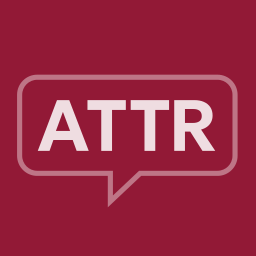
As patients, it's easy to wonder if anyone is listening. We share our stories over and over again. We speak on panels. We participate in research. We tell our stories to pharmaceutical companies, websites, support groups, and anyone willing to learn.
Sometimes it can feel like tossing a pebble into the ocean and wondering if it makes any difference at all.
Today felt like seeing a ripple.
Not because my doctor knew who I was, but because she knew about ATTR.
She knew enough that I didn't have to start from square one.
She knew enough that a rare disease didn't feel quite so rare in that moment.
Awareness doesn't happen overnight. It happens one conversation at a time. One patient story at a time. One article at a time. One video at a time.
When my dad was diagnosed, awareness was almost nonexistent. Today, a doctor walked into an exam room already familiar with the disease that changed my family's life forever.
That's progress.
Featured Forum
View all responsesAdvocacy is necessary when patients feel alone
There is still so much work to do. Too many people are still waiting years for a diagnosis. Too many families are still hearing the words "I've never heard of that before." Too many patients still feel alone.
But today reminded me that we are moving forward.
It reminded me that every story shared has the potential to educate someone.
It reminded me that every advocate is helping pave the way for the next patient.
And maybe most importantly, it reminded me that my dad's story continues to matter.
Carrying hope into every appointment
The disease that was once virtually unknown to the people around us is now being recognized by healthcare providers who may have never heard of it 15 years ago.
As I left that appointment, I felt something I wasn't expecting.
Hope.
Hope that awareness is growing.
Hope that diagnoses will come sooner.
Hope that patients will feel less alone.
And hope that all those videos, all those advisory boards, all those articles, and all those stories are helping create a future where no one has to explain their rare disease from the beginning every single time they walk into a doctor's office.
Today, for the first time in a long time, I didn't have to start over.
And that felt like a victory worth celebrating.
Join the conversation